
The Coffee Chat (#102)
My conversation with Maurizio Cuna: Partner at Infosys Consulting; Author: Beyond Slides; Writer: Consulting Intel newsletter and Dad to 1!

Welcome to the new subscribers who have joined us since the last post. Today this email is going out to 2,035 amazing individuals!
If you’re reading this but haven’t subscribed, you may want to consider doing that. This will ensure future posts land straight in your inbox.
Hi there 👋🏽
There’s a lot of chatter right now about the “right age” for women to get married or have children.
The truth is simple: there is no universal timeline. Every path has trade-offs.
I spent my late teens and 20s working intensely and did experience career acceleration. Then I got married in my late 20s and kids soon followed. By most measures, my career has been strong.
Did having kids introduce a pause in that acceleration? Yes - and it was a conscious choice, not a setback.
Would I make the same choices again? Absolutely.
Do I believe I can return to a high-growth trajectory in the coming years? Without hesitation. Ambition doesn’t disappear; it evolves.
Unfortunately, women do face real workplace biases, especially after becoming mothers.
The real problem isn’t women’s choice to become mothers.
It’s that society pits two timelines against one another - biological clock and career clock - and tells women to solve a conflict they didn’t create.
Here’s my advice to women navigating this:
Talk to women 10–20 years ahead of you - the ones whose careers and lives you admire.
Ask what worked, what didn’t, and what they wish they’d known.Choose the timeline that aligns with your values, your energy, and your long-term vision. There will always be trade-offs but they should be yours to make.
Trajectory is rarely linear, for men or women. Leadership depth often grows during the years a lot of individuals felt they were “slowing down”
☕ Now, on to today’s coffee chat…
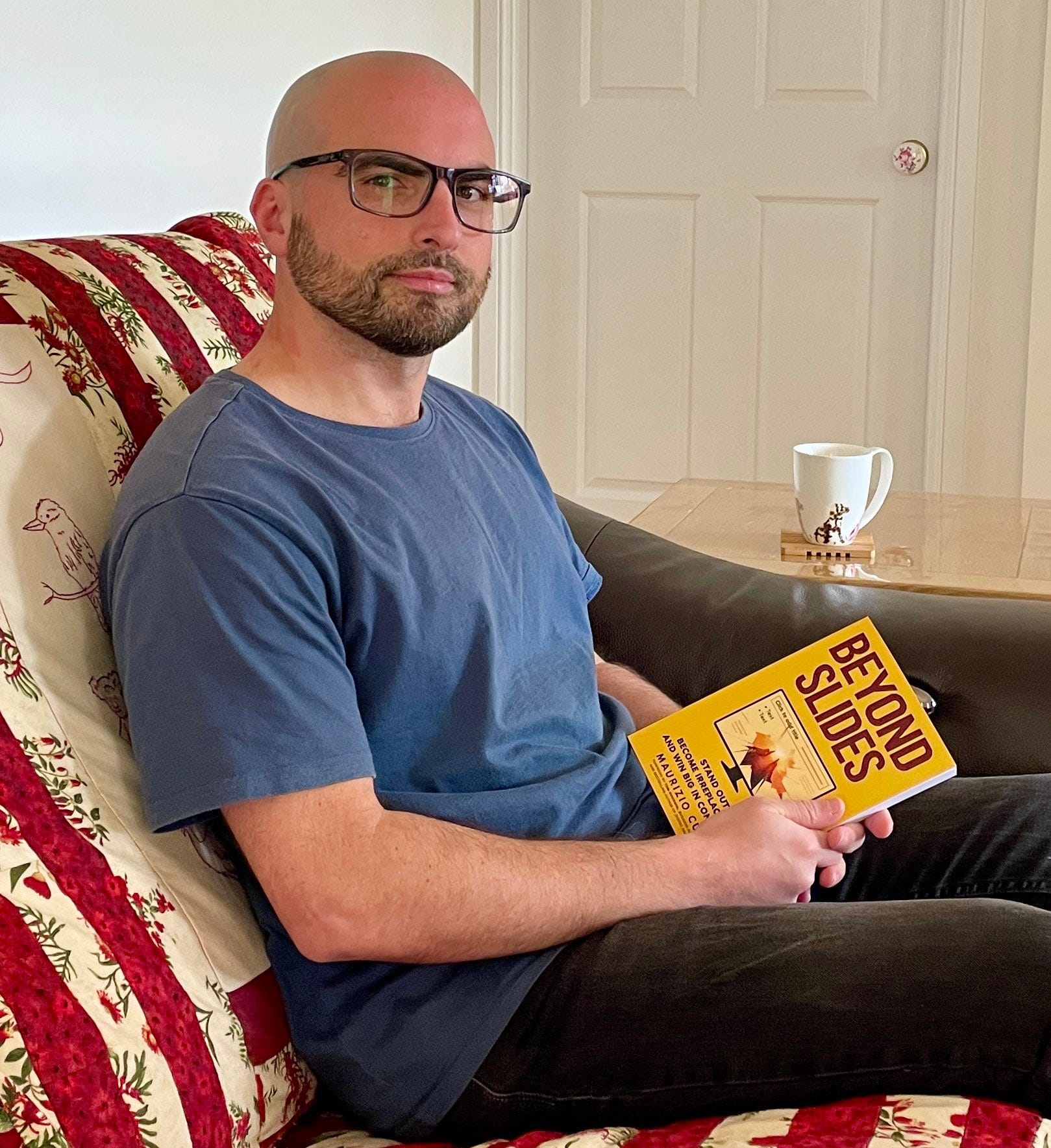
Meet Maurizio Cuna
or MC, as most people call him - is a Partner at Infosys Consulting, where he leads complex transformations in banking and insurance at the intersection of technology, strategy, and human behaviour. With over 20 years of experience spanning four continents, he has advised global firms on core banking transformations, platform modernization, large-scale digital programmes, and AI integration.
Beyond consulting, he is the bestselling author of Beyond Slides, a #1 Amazon bestseller across multiple countries, and a generous mentor to the next generation of consultants.
Now based in Sydney with his family, he is as passionate about thoughtful transformation as he is about cooking Italian food from scratch, playing football, and reading more dead authors than he probably should.
We got to know each other through social media, drawn together by our shared love of writing and thinking out loud. We have been exchanging and bouncing perspectives back and forth across time zones and a giant ocean.
Below is my conversation with Maurizio….
Please tell us a little bit about yourself
I was born in Italy, which is not where I live now. I live in Sydney, Australia, which is pretty much one of the furthest points you can get from Italy…especially from the south of Italy, where I was born.
I was born in the south and then moved up to Padova, which is near Venice. Most people are familiar with Venice. I studied there and then started working for Accenture in Milan. That lasted for a bit.
About 2 decades back, I decided to move to the UK. The idea back then was pretty simple: move to the UK, learn a bit of English, and then go back to Italy after a couple of years. Instead, I ended up living in the UK for almost a decade.
After that, I moved to Hong Kong for a couple of years, did a bit of time in the US, and now I’ve been in Australia for almost 10 years. So that part of the plan definitely changed, I never really moved back.
I got married to a girl from Australia. We met in London, in the UK. Then, after moving here for a project that was supposed to last a couple of years, at the end of the project we were meant to go back to the UK. But after experiencing the Australian lifestyle, we decided it was much better here. There’s definitely more sun.
So we decided to stay. We have a daughter - she’s eight now. She’s fluent in Italian and, of course, English. She’s able to speak with my mom in Italian, which is something that was really important to us. We wanted her to be bilingual. And of course, she lives here, so English is very natural for her.
You’re also an author, right? That’s something you didn’t mention just now, but you’re a published author as well.
Yes. I do a few things.
Professionally, I’m a management consultant. I currently work as a partner at INFOSYS CONSULTING, which is the consulting arm of Infosys, based here in Australia.
On top of that, I write a newsletter called Consulting Intel. I started it about a year or so ago, and now it’s read by several thousand consultants all over the world - in about 127 countries, last time I checked. So there’s definitely been a lot of interest.
June 2025, I also published my first book. It’s titled Beyond Slides. I frame the book as part memoir, part philosophical essay, and part survival manual for consultants who want to have a long career.
So I do a lot of things along with my busy job.
And that’s actually a good segue into a follow-up question.
You’re a dad, and you’ve been in consulting for about 20 years now. Regardless of which consulting firm you work with, when you’re serving clients, there’s always a certain level of intensity and pressure involved.
I don’t love the words “balance” or “boundaries,” but how do you navigate that intensity? Especially given that you’re not just a parent outside of work - you’re also an author, you write a newsletter, and you’re very active on social media platforms. What kind of life have you created that allows all of this to work?
Yeah, I also don’t like the word “balance.”
I really don’t believe that life is made up of two or three or four separate things. There is one thing, which is life. And within life, there are things that we do. Work is an important part of it, of course but so is family, hobbies, and finding creative outlets.
The way I structure things is that I like to think in weeks rather than days. That’s how I organize my life.
First of all, very naturally, I don’t like watching TV. I don’t like Netflix. That comes very naturally to me. When I talk to other people about this, they say it probably saves me 10 hours a week or even more. I just don’t enjoy it. I feel very bored. If I’m forced to watch TV for more than 20 minutes, I’m bored.
I also don’t enjoy shopping centers or that kind of stuff. They stress me out too much. So I buy everything online, or my wife goes - she likes it, so she does her thing.
My hobbies are writing and playing football. I still play football. I’m 41, and I’ve been playing since I was five. It’s something I really enjoy, and it keeps me in the moment. Obviously, it’s also a motivation to stay as fit as possible. I’m less fit than when I was 20, but I’m still reasonably fit.
I play in a competition every Saturday. It takes a couple of hours, but I enjoy the training as well it’s not a chore. It’s genuinely how I have fun.
I’m very strict about time and energy management. That’s really how I manage myself.
I wake up very early, naturally between 4:30 and 5:00 a.m. No alarm. I don’t set an alarm at all. The only time I would set one is if I had to catch a flight, which I don’t enjoy anyway. For the past 10 years, I haven’t set an alarm. I just naturally wake up around 4:35.
That means I go to bed relatively early around 10:00 p.m. I try to get between six and seven hours of sleep.
The early hours of the morning are when I do my most creative work. That could be personal work, but it could also be work-related. If I need to work on a presentation, a deck, or something like that, I’ll do it then. I go from zero to 100 very quickly within five minutes I’m fully alert. I don’t need a slow start. Most people do; I don’t. I’m lucky that way.
If I go into the office, I have a long train ride about an hour. That helps me focus my thoughts, take notes, write, and do emails.
If I’m working from home, I usually take my daughter to school in the morning. By 8:30, I’m back and ready to start work at around 9:00, depending on the first call.
So I try to integrate all of these activities into life. There’s no “balance” for me. I’m very happy to work on a Saturday or Sunday - I really don’t care. I’m happy to take a phone call at 8:00 p.m.; it honestly doesn’t bother me. But if I need to do something at 1:00 p.m. on a Tuesday, I have a lot of flexibility to do that too.
I really like that, because that’s very similar to how I think about things.
For me, it’s about energy. A lot of these rules feel artificially created. If I need to pick something up on the weekend, I’m fine with it as long as I enjoy it and still have space during the week to do other things when I need to.
That brings me to another question. Through your newsletter, your writing, and your own experience - what’s a big misconception about consulting as a profession that you wish to dispel? Especially for aspiring consultants who feel like, “I can’t have a life outside of work.” A lot of people fall into that trap and assume that being a career consultant means you’re just going from project to project, and that’s it …that you can’t possibly have a life outside of it.
I think there are seasons in everyone’s life. And I don’t want to lie - when I was in my 20s, my life and my focus on my professional career were very different from what they are now.
That was also a function of the type of consulting I was doing at the time. When I was younger, I worked for a boutique specialist consulting firm that specialized in core banking. Core banking transformations are massive programs. They’re very risky, they cost a lot of money, and they used to be described as doing heart surgery while the patient is still alive because you’re changing the core systems that run a bank.
So I worked in that domain. These kinds of projects don’t happen very often in one city, or even in one country. As a result, I had to travel a lot. That’s how I ended up working in, I don’t know, maybe 10 different countries by now. I would finish one project and then move to the next project in a different country or continent.
While I was based in London, it was absolutely not unusual for me to work Monday to Friday in a completely different place. For example, I was living in London, but I would do 15 days in the US, then go back to London, then one week in Poland, where my team was, then one week in London, then two weeks in the US again. That was my rhythm.
Obviously, I was much younger, and I didn’t have children. That’s a huge difference. At that stage, I was very focused on that part of my career.
If you want to live that lifestyle for 50 years, then to me it’s kind of obvious that you need to sacrifice something else. But if you use your early years in consulting as an accelerator for the second stage of your career, then I think that’s a wise move.
You can use the accelerated growth you experience in your first 10 or 15 years and then leverage that in the second part of your career when maybe you have a family and different priorities. And you can leverage that not necessarily to work less, because if I look at my working hours, they’re still quite substantial but I work differently.
As you gain new roles in a firm, the nature of your work changes. Each new role is different from the previous one, and you have to improve different types of skills, often shifting from hard skills to soft skills.
That’s a big debate. For example, in my book, and I’m not trying to plug it, I talk about the foundational skills consultants need to develop if they want to work in consulting for a long time.
I think young consultants focus disproportionately on domain skills or hard skills, and many of them completely ignore the softer side. Then they complain and say, “Why did that person get promoted and I didn’t?” Well, you have to think holistically about the challenge and reflect on what you could have done differently - what that person might have done that you didn’t.
I completely agree with you. And I think that’s why your book is titled Beyond Slides, right?
There’s a misconception that consulting is just about creating slides or building Excel model after Excel model. While that’s important, we don’t even need to get into the conversation about AI tools and how that’s becoming faster and easier.
I keep telling people consulting is a team sport and a human business. At the end of the day, you have to influence people, coach them, understand their insecurities, and navigate human complexity.
I really like the fact that through your book you’re encouraging people to think this way. And I’m not trying to force a “consulting meets parenting” conversation, but I am curious - are there skills you acquired as a consultant that helped you as a parent? Or vice versa? Did becoming a dad give you a whole new set of skills that actually made you a better consultant?
Yes, absolutely. I think that really happened.
First of all, having a child and especially seeing someone grow from zero to who they are today you learn from them. You learn from kids. As much as you want to teach your child, you also have to be able to learn from them.
The way my daughter looks at new things is incredible. Sometimes I wonder if I was the same when I was young, I probably was, but I forgot. She’s incredibly curious. She keeps that curiosity open for pretty much everything. She asks a lot of questions, and she doesn’t come in with pre-judgment.
Kids are very open-minded, whereas adults have decades of embedded societal norms - what they read, what they’re told, what they absorb over time.
Staying curious has definitely made me a better consultant. The way you ask questions, the way you frame questions, and how you move from one question to the next, it really matters.
We talk about the “five whys” in consulting. With my daughter, it’s more like the 15 whys. She doesn’t stop. And maybe there’s something there we can learn from.
Has your idea of success or even ambition or growth evolved as you’ve taken on these different roles? You’re not just a consultant anymore. You’re a consultant, a father, a writer, and whether you like the term or not an “influencer” - someone who is quite public with their thinking in the profession.
Has all of that changed what success means to you?
Probably, but I don’t really come at it from that angle.
I don’t do any of this because I’m chasing some definition of success. For me, it’s really about enjoyment. I like to write. I always had the idea that one day I would write a book, because I like to read. Reading has been a habit of mine since I was a kid.
And by the way, I’m very happy that my daughter loves to read as well. Even this morning, she was just sitting on the sofa with a book. I like to think that she looks at me and thinks, “Okay, this is a good habit,” and then she does it too.
I always wanted to write a book, and I finally did. I like to read deeply
I write the newsletter and I write my thoughts because, honestly, I didn’t realize there was interest. This was something I had never tested before or even experienced.
When I started writing online, I genuinely thought nobody would read it. And instead, very quickly, to be fair, there was a lot of interest. A community of consultants started to form around what I was writing.
So I thought, okay, maybe there is interest. Maybe I’m actually helping other people. And then, after I published the book, I kept receiving messages from people who really liked it and who said they were finding it helpful in their profession.
At that point, I realized: okay, there is interest. People are finding this useful. I like doing it. It doesn’t add stress to my life. So it’s kind of a no-brainer to continue writing.
I relate to that so much.
Like you, TV does nothing for me. There are books everywhere in my house, probably close to a thousand. I really enjoy reading and writing.
And very similar to you, I thought, “Who cares about my thoughts online?” But once you start putting yourself out there, a few things happen. Your thinking gets refined, and people sort of find you.
I think there’s also a personal process involved. For me, at least, that was the case.
I’m very effective one-on-one, that’s always been true for me, but I don’t think I’m naturally very effective in public speaking situations, especially when there are a lot of people in front of me. That was something I always wanted to fix.
So I went through this process of saying, okay, let me take this fear - this aspect of my personality where I feel weak, or at least not as strong as I could be and let me attack it directly.
I started writing in public to confront that fear and say, “Okay, let’s do this and see what happens.” And like with everything, once you start doing the thing, your brain moves from fear to solution. You start finding ways to improve and get better.
Of course, I have reasonably solid skills in writing and communication, and I know what I’m talking about because I’ve been doing this job for 20 years. I’m not a random person on the internet who’s never experienced consulting.
So naturally, it resonates a bit, which is good. But I’ll keep improving. I still see a lot of areas where I can get better.
I love that. And honestly, that’s how you and I are connected halfway across the world through the power of the internet.
One thing I remember reading, you might have written it on LinkedIn, was this idea that “one day” is a dangerous concept. There’s a certain urgency in how you approach life.
Can you tell me a bit about where that idea came from and how you live it day to day?
Yes. That idea actually goes back to when I was five years old.
I started primary school one year early. At the time in Italy, you could start school at five instead of six. Then I finished high school one year early as well.
There was a scheme back then, I’m not sure it still exists, where, if you were getting certain marks, you could compress the last two years of high school into one., you could compress the last two years of high school into one. That meant I started university two years ahead of my peer group.
This might sound absurd to people outside Italy, but the average length of a computer engineering degree at my university was nine years.
Wow - 9 years!!
Yes - 9 years was the average. It wasn’t unusual for me to be 17 years old and sitting next to a 30-year-old student.
I finished university in five years. So I always had this sense of wanting to get there to move forward. That urgency you mentioned has been there since very early on, and it’s still there today.
I don’t like wasting time. I’m extremely optimized in how I spend my energy and my attention. I like doing many things at once. I always have multiple things going on.
Consulting suits my personality very well because I can have 10 or 15 projects at the same time across different clients. That variety keeps me engaged. I’m always learning, always doing something different, so I never get bored.
I don’t know if that’s just how my brain works or a personality trait that comes naturally to me but it’s not something I had to learn. It’s just always been me.
As we start wrapping up, I wanted to ask something broader. You’re now a partner at a consulting firm. You’ve had a long 20-year career, and hopefully an even longer one ahead. You write a lot about the industry, and you have influence within your practice.
How do you think consulting as an industry can do a better job of retaining parents, especially mothers? I’ve seen incredibly talented women leave for various reasons.
Given your experience with parenthood and the demands of the job, what are your thoughts on how consulting can make this work better?
I can say that over the last several years, there has already been a huge improvement, and the attention on this issue has increased significantly.
When I started my career, nobody talked about this - literally nobody. Now, at least, it’s part of the conversation.
Some of the things we’ve done include creating programs to support new mothers returning to the workforce. We offer specific training and create opportunities for more flexible ways of working.
That flexibility has allowed us to attract many women with strong industry experience back into consulting.
This idea that once you have a child you’re suddenly no longer “useful” is completely crazy. If anything, you were good before and now you’re even better.
The key is flexibility and recognizing that being a parent comes with additional responsibilities. If firms are receptive to that, it helps everyone.
Sometimes clients can be quite strict about expectations, and I’m very comfortable having tough conversations with them. I’ll say, “We need to ensure flexibility for our consultants, because they have responsibilities at home that need to be respected.”
Most of the time, honestly, about 99% of the time, people are receptive. There’s always room for improvement, but I can safely say there’s been significant progress and a lot more attention paid to this topic.
Quick-fire Questions:
What’s the best thing you have read recently?
I could give you many titles. The problem is….how many do you want? One thing I always recommend is the work of Nassim Nicholas Taleb.
I’ll try to give you a few titles that are a bit less obvious, otherwise everyone ends up recommending the same books.
One book I recommend is The Sovereign Individual.
And then I’ll give you a more controversial one: How I Found Freedom in an Unfree World by Harry Browne. I’m not American, but I understand that Harry Browne was a politician with very specific political views around liberalism, which at the time were considered quite radical in the US when he wrote the book.
He’s no longer alive, and the book is several decades old. But if you ignore the political framing, the book itself is very provocative in a good way.
What’s the best thing you have heard recently?
The music I listen to mostly comes from my time as a punk rock drummer about 20 years ago so that kind of dates me.
I could tell you bands like Lagwagon or Jimmy Eat World - that’s kind of where I’m at musically.
I do listen to podcasts. I tend to listen to very popular ones rather than unknown ones, so the names I mention will be familiar.
I like The Tim Ferriss Show. I like Founders, the podcast where the host reads biographies; I find that fascinating. I also listen to Modern Wisdom.
And I like The Memo by Howard Marks. Howard is a major investor. He used to write a memo every month, and now those memos have been turned into a podcast. So if you don’t want to read the memo, you can listen to it while you’re doing other things.
🤓 Open tabs…
(I have modeled this section after those “open tabs” that we all have with a few (okay 30-40) interesting links that we promise we will eventually get to one day. These are the links that I had open for sometime that I finally got to …)
⭐When Your Kid’s Best Friend Is a Great Big Problem
A natural impulse is to forbid contact - but that’s likely to backfire. “I feel like I’ve lost my daughter,” she said. “Ever since she started hanging out with those girls, she’s become a different person.” She told me how her daughter had become obsessed with her appearance, was constantly on her phone, and had lied about doing her schoolwork. “I want to tell her she can’t see them,” the mother said, “but I’m afraid that will only make things worse.”
⭐Reading Is a Vice
Being a reader means cultivating a relationship with the world that, by most standards, can seem pointless and counterproductive.
⭐Why pleasure is the key to self-improvement
Forget puritanical self-discipline – the way to really make a new habit stick is to lace it with instant gratification
📖 My private thoughts from my very public diary…
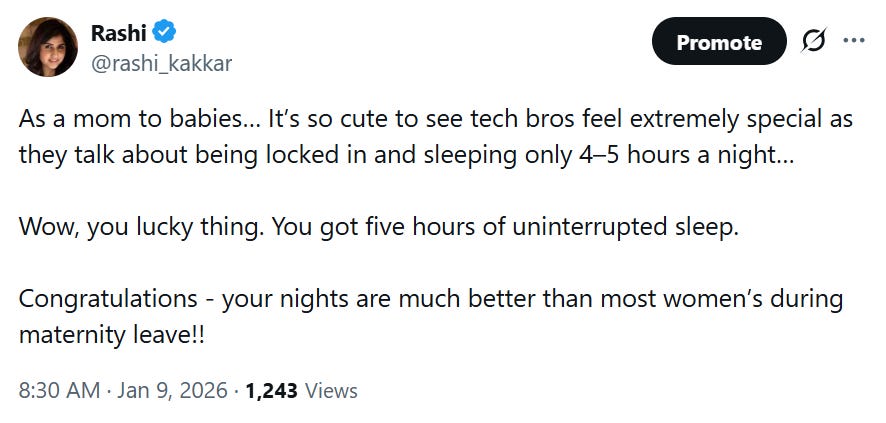
(Sometimes on X (Twitter), sometimes on Threads and sometimes on BlueSky)
If you enjoy Decks and Diapers, it would mean the world to me if you invited friends to subscribe and read with us. If you refer friends, you will receive a little something from me as a thank you!
If that feels like too much then, did you know that liking this post or leaving a comment helps it find more readers?
P.S. If this email landed in your Promotions tab, please take a second and drag it to your Primary tab. It makes a big difference to the inbox gods, plus you’ll never miss a post!
Disclaimer: All views expressed are my own and do not necessarily reflect the views of my employer
Great discussion. Enjoyed reading about Maurizio’s journey and the candid answers!
Thanks for the chat Rashi! 🙏